You know the drawer. Nearly every home has one. That drawer in the kitchen where everything goes to disappear. The scissors. A handful of mystery keys. Dried-up pens, rubber bands, a twist tie collection, misc tools, flashlights, coins, coupons. At least one instruction manual for an appliance you don’t own anymore.
You’ve probably opened it, sighed, closed it, and told yourself you’ll deal with it later.
And then “later” arrives, and you find yourself deep in an online rabbit hole buying a set of bamboo drawer dividers that you think will finally fix everything.
Here’s the thing: they won’t. Not yet, anyway.
If it makes you feel any better, you are far from alone. A 2024 survey found that 95% of Americans admit to having at least one junk drawer in their home. And a dedicated 16% have taken things to the next level with more than three. So yes — this is basically a universal human experience.
I was recently asked to share my expertise with HGTV Magazine, and my honest answer probably surprised them — because after more than a decade of organizing professionally, my number one tip isn’t about products at all.
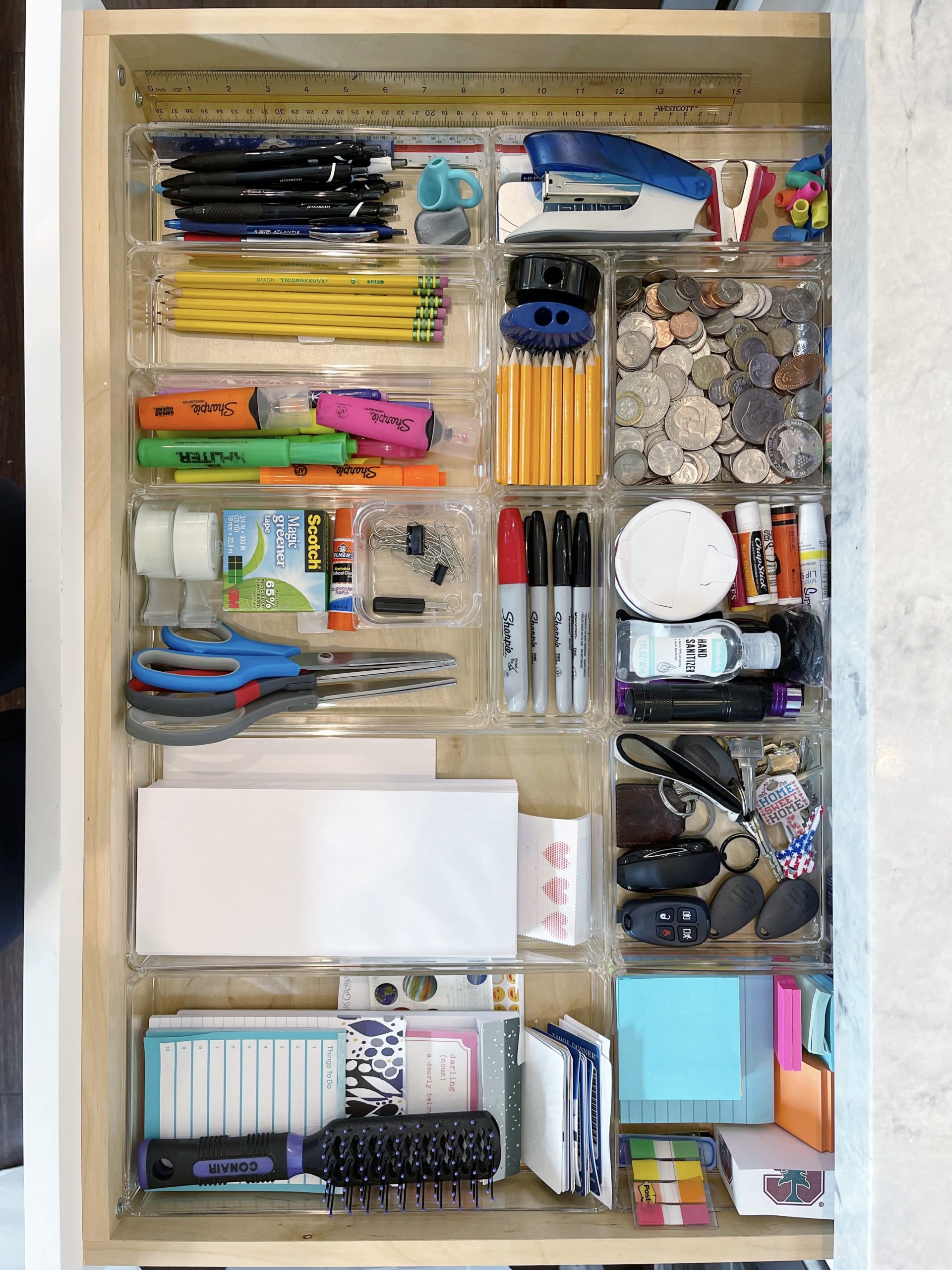
Most Junk Drawer Problems Are “Too Much Stuff” Problems
The truth is your junk drawer isn’t disorganized because you need better bins. It’s disorganized because there’s probably too much in it.
Here’s a quick test. Go count your scissors. Most people find six to eight pairs floating around their home. Eight pairs of scissors — and somehow, none of them are ever where you need them.
Same goes for pens. Pull them all out, test every single one, toss the dead ones. Keep five or six. That’s plenty.
Once you start seeing your junk drawer through that lens — a volume problem, not an organization problem — the solution becomes a lot simpler. And a lot cheaper.

Start Here: Empty Everything Out
Before you buy a single thing, pull everything out of the drawer and wipe it clean. Get it all onto the counter where you can actually see what you’re working with.
Then ask yourself two questions for each item: Do I actually use this? Do I even know what this is?
If you haven’t used something in a year, it’s taking up valuable space. And that mystery key? The dried-up superglue? The manual for the blender you donated years ago? You have permission to throw those away. I’m giving you permission right now.
For things you have multiples of — rubber bands, twist ties, batteries — keep what fits comfortably in the drawer and relocate or purge the rest.
Group by How You Actually Live
Once you’ve been honest about what’s staying, group like items together. My go-to categories are writing utensils, batteries, tape and adhesives, tools (scissors, screwdrivers), office supplies, and a small catch-all for true miscellaneous. The things you reach for most often should live front and center.
Here’s something important: you don’t need a separate container for every single category. A few items can share space. The goal is function, not perfection. If you can open the drawer and find what you need without digging, it’s working.
Look Around Your House Before You Shop
Before you buy anything, take a lap around your home. Old checkbook boxes, small gift boxes, shallow food storage containers you’re not using, even folded pieces of cardboard — all of these create perfectly good dividers. The goal is to contain categories, not to create a magazine spread. I’ve organized many junk drawers using nothing but what clients already had on hand.

If You Do Buy Something, Keep It Simple
Here’s my honest take: most people don’t need to buy anything for a junk drawer. I know that’s not what you’d expect a professional organizer to say, but it’s true.
If you’ve done the work — decluttered, grouped your items, and still feel like you need a little structure — then a basic expandable drawer divider or simple compartment trays are all you need. Measure your drawer first so you’re not forcing something that doesn’t fit. That’s it. Nothing fancy required.
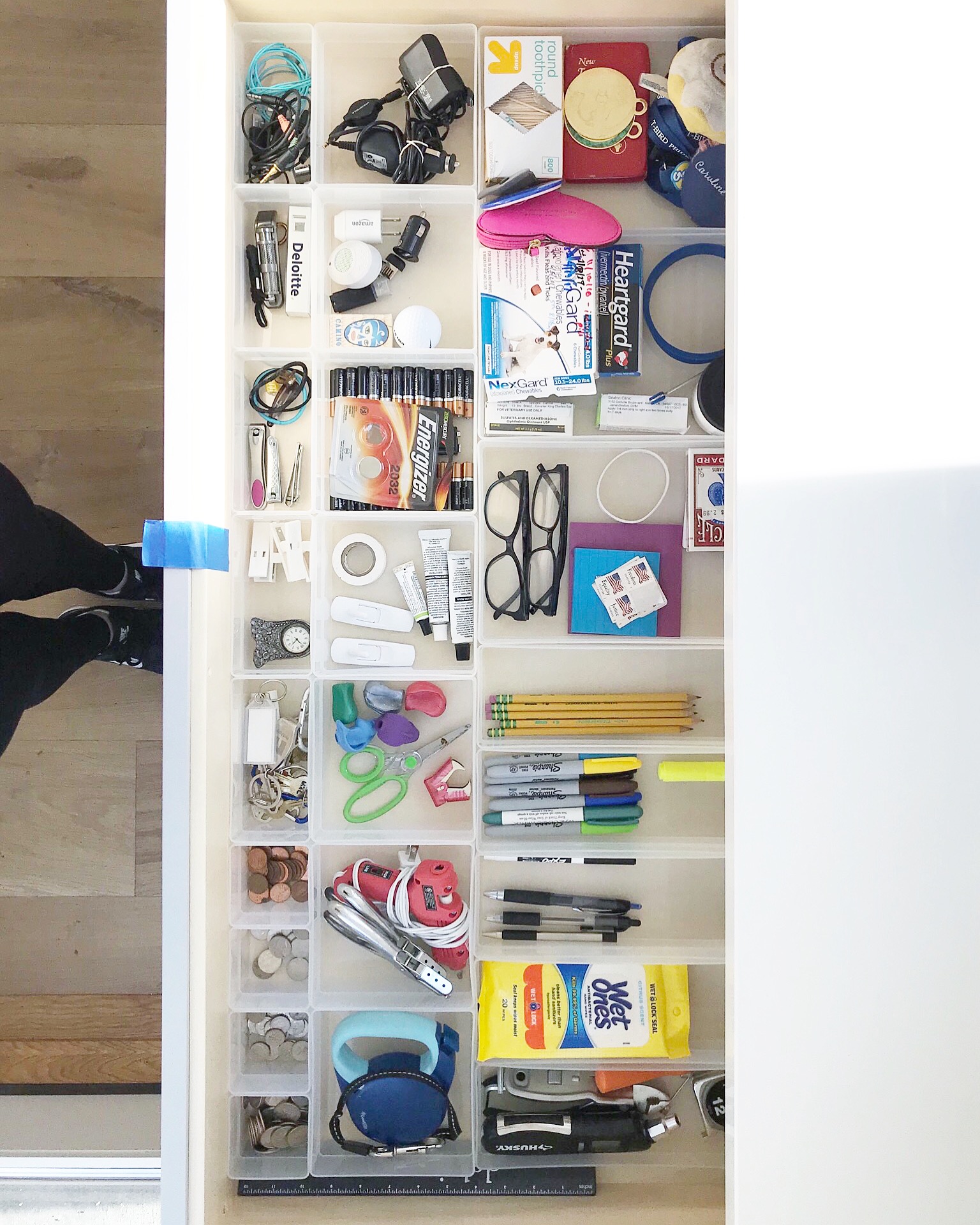
This is a recent product I discovered that uses every inch of the drawer and you can customize the sections…

A system like this is easy to install and it comes in a few other colors to match your drawer box.
The Bottom Line
A junk drawer doesn’t need to be beautiful. It needs to be functional. And functional almost always starts with less — less stuff, less clutter, less convincing yourself that the right product will do the work that only decluttering can do.
Get rid of what you don’t need, and the organization part basically takes care of itself.
Another note on junk drawers. When I notice someone is stuck or frozen and unsure of where to begin, I always suggest starting small. A junk drawer or any drawer is really a good place to get that wind in your sails. A junk drawer clean out really impacts your mood and motivation to keep going. Most of us open that junk drawer once a day. Imagine how good it will feel the next time you open it after decluttering.
If you’d like to read the HGTV article, you can find it right here!
As we head into Spring Cleaning season, maybe starting with your junk drawer is a good jumping point. Where do you plan on cleaning up around the house this Spring?
Back soon!
xo,
Sam
comments +